

Incoterms, or International Commercial Terms, are standardized rules published by the International Chamber of Commerce (ICC) to clarify responsibilities, costs, and risks between buyers and sellers in global trade.
The latest version, Incoterms 2020, includes 11 terms split by transport mode, helping logistics firms like Trailblaze Supply Chain avoid disputes in freight forwarding.
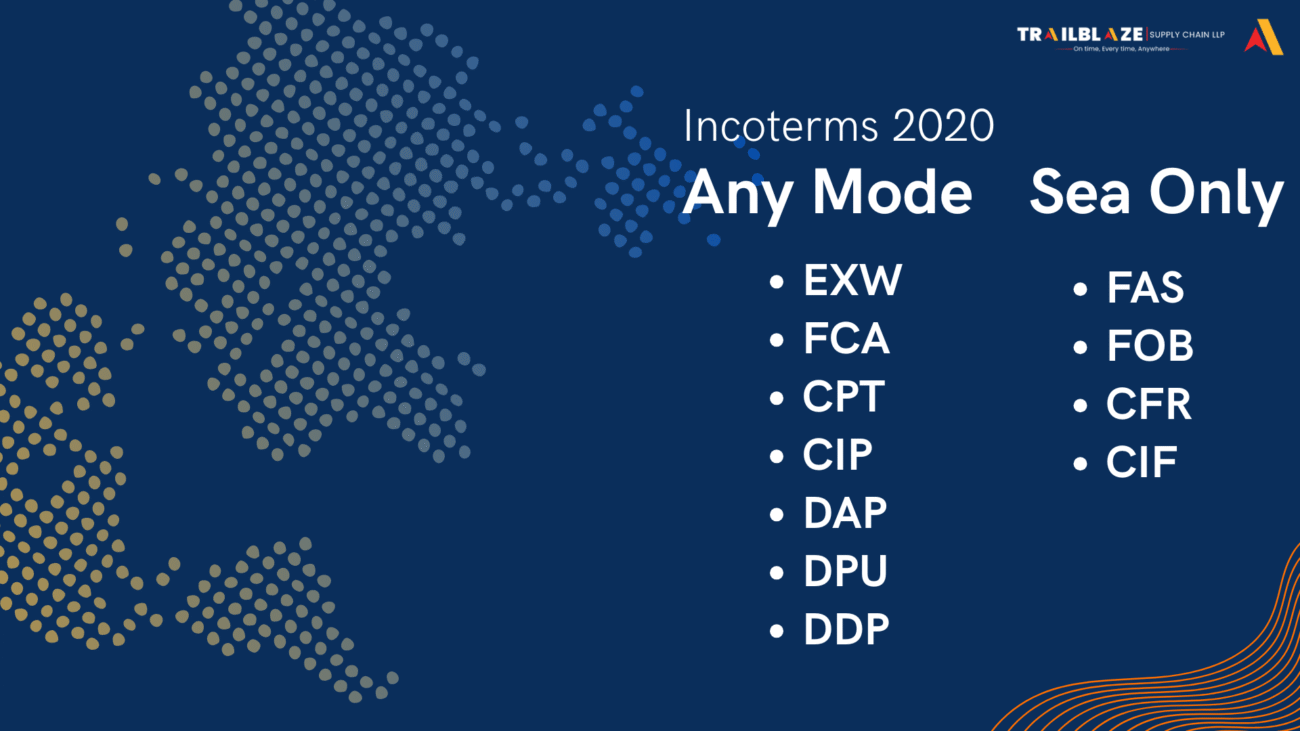
What Incoterms Cover
Incoterms define who handles carriage, insurance, export/import clearance, and when risk transfers from seller to buyer. They apply only to the goods’ delivery, not payment, title transfer, or contract breaches—always specify the version (e.g., “CIF Incoterms 2020”) in contracts.
Incoterms – 2020
Incoterms 2020 define 11 standardized trade terms, with risk transfer points marking when responsibility shifts from seller to buyer.
| Term | Abbreviation | Risk Transfer Point |
|---|---|---|
| Ex Works | EXW | Seller’s premises |
| Free Carrier | FCA | Delivery to carrier |
| Carriage Paid To | CPT | Handover to first carrier |
| Carriage and Insurance Paid To | CIP | Handover to first carrier |
| Delivered at Place | DAP | Named destination (unloaded) |
| Delivered at Place Unloaded | DPU | Named destination (unloaded) |
| Delivered Duty Paid | DDP | Named destination (ready) |
| Free Alongside Ship | FAS | Alongside ship |
| Free on Board | FOB | On board ship |
| Cost and Freight | CFR | On board ship (origin port) |
| Cost Insurance and Freight | CIF | On board ship (origin port) |
EXW (Ex Works)
Seller’s minimum obligation: makes goods available at their premises. Risk transfers immediately at the factory gate—buyer handles all export clearance, transport, and costs from there.
FCA (Free Carrier)
Seller delivers goods, cleared for export, to a carrier or designated place (e.g., terminal). Risk shifts when carrier takes control, balancing duties for most international sales.
CPT (Carriage Paid To)
Seller pays carriage to a named destination but risk passes to buyer once goods reach the first carrier. Ideal for containerized non-sea shipments where seller contracts freight.
CIP (Carriage and Insurance Paid To)
Like CPT, but seller also provides minimum insurance coverage until destination. Risk still transfers early to first carrier, protecting seller while giving buyer insurance control.
DAP (Delivered at Place)
Seller bears all transport risks/costs to a named destination place, ready for unloading. Buyer handles import clearance and unloading—common for door-to-door efficiency.
DPU (Delivered at Place Unloaded)
Seller delivers and unloads at named destination (replaced broader DAT rule). Risk transfers post-unloading; buyer manages import formalities—precise for specific sites.
DDP (Delivered Duty Paid)
Seller assumes maximum risk: handles everything including import duties/taxes to buyer’s disposal. Risk transfers only when goods are fully ready—buyer-favored but costly for seller.
FAS (Free Alongside Ship)
Seller delivers goods alongside the buyer’s nominated vessel at the origin port (e.g., stacked on quay ready for loading). Risk transfers when goods are positioned alongside the ship; buyer handles vessel loading, ocean freight, and all clearance.
FOB (Free on Board)
Seller clears goods for export and loads them onto the buyer’s vessel at the named origin port. Risk shifts once goods pass the ship’s rail (on board); buyer assumes ocean transport, insurance, and destination formalities—classic for bulk exports but outdated for containers.
CFR (Cost and Freight)
Seller pays all costs including ocean freight to the named destination port but risk transfers early when goods are loaded on board at origin port. Buyer manages unloading, import clearance, and post-arrival risks; no insurance obligation on seller.
CIF (Cost, Insurance and Freight)
Identical to CFR for costs/freight to destination port, plus seller provides minimum marine insurance (Institute Cargo Clauses C). Risk still passes on board at origin port, allowing buyer to arrange additional coverage; widely used but requires specifying “Incoterms 2020” to clarify insurance level.
Any Mode of Transport (7 Terms)
These versatile rules suit air, road, rail, or multimodal shipments:
| Term | Seller Responsibilities | Buyer Responsibilities | Risk Transfer Point |
|---|---|---|---|
| EXW (Ex Works) | Minimal: Prep goods at origin | All transport, risks, costs from factory gate | Seller’s premises |
| FCA (Free Carrier) | Export clearance, deliver to carrier | Main carriage, import clearance | Carrier handover |
| CPT (Carriage Paid To) | Pay main carriage to destination | Unloading, import clearance | When handed to first carrier |
| CIP (Carriage & Insurance Paid To) | As CPT + minimum insurance | Unloading, import | First carrier |
| DAP (Delivered at Place) | Carriage to named place, export clearance | Unloading, import | Named destination |
| DPU (Delivered at Place Unloaded)* | As DAP + unloading | Import clearance | Unloaded at destination |
| DDP (Delivered Duty Paid) | All to buyer ready, including import duties | Take delivery | Buyer’s disposal |
Sea & Inland Waterway Only (4 Terms)
For ocean bulk/container shipments:
| Term | Seller Responsibilities | Buyer Responsibilities | Risk Transfer Point |
|---|---|---|---|
| FAS (Free Alongside Ship) | Deliver alongside vessel | Loading, ocean freight | Alongside ship |
| FOB (Free on Board) | Load onto vessel | Ocean freight, insurance | Over ship’s rail |
| CFR (Cost & Freight) | Ocean freight to port | Unloading, import | On board at origin port |
| CIF (Cost Insurance & Freight) | As CFR + minimum insurance | Unloading, import | On board at origin |
Key Differences: All Modes vs Sea Terms
All Modes terms (EXW-DDP) flex across air/road/rail/multimodal for modern containerized trade, with risk often shifting at carrier handover or destination. Sea Only terms (FAS-CIF) lock to ocean/inland waterways for bulk/non-containerized cargo, tying risk to ship-side events like “alongside” or “on board” at origin port.
Quick Comparison Table
| Aspect | All Modes (7 Terms) | Sea Only (4 Terms) |
|---|---|---|
| Transport | Air, road, rail, multimodal/containers | Ocean bulk/RO-RO, inland waterways only |
| Risk Shift | Flexible (premises to destination) | Ship-focused (quay, rail, on board origin) |
| Best For | Coimbatore exporters via air/road to world | Kerala bulk commodities via Cochin port |
| Containers? | Yes, modern standard | No—outdated for 20ft/40ft boxes |
| Insurance Note | CIP offers full coverage (Clause A) | CIF minimal (Clause C) |
Sea-only Incoterms (FAS, FOB, CFR, CIF) are considered outdated primarily because global trade has shifted to containerized, multimodal shipping since the 1960s, rendering ship-specific risk points impractical.
Core Reasons for Obsolescence
Containerization revolutionized 90%+ of ocean trade: goods load into sealed 20ft/40ft boxes at factories, trucked to ports, and shipped without “ship’s rail” handling. Sea terms assume bulk/breakbulk cargo where physical placement alongside/onboard matters—containers bypass this entirely.
Practical Mismatches
- FOB/FAS Imprecision: “On board” or “alongside” doesn’t apply to pre-loaded containers handed to carriers inland (e.g., ICD in Coimbatore). Using FOB risks disputes over who controls the container pre-port.
- Early Risk Transfer: CFR/CIF pass risk at origin port loading, but containers travel 2-3 weeks inland first—buyers bear ocean freight costs despite no control.
- Legal/ICC Warnings: Incoterms 2020 explicitly limits these to non-container sea/inland waterway; ICC recommends FCA/CIP equivalents for modern flows to avoid claims.
Modern Alternatives
| Outdated Sea Term | Container Equivalent | Why Better |
|---|---|---|
| FOB | FCA (terminal/carrier) | Inland handover, full export clearance |
| FAS | FCA (port quay) | Matches container staging |
| CFR | CPT | Seller pays freight, early risk ok |
| CIF | CIP | Full insurance (Clause A vs C) |
95% of Indian exports use FCA/CIP—avoid sea terms unless bulk commodities like spices/minerals. Misuse delays payments 30+ days via disputes.
For exporters in India favor FCA or CIP to limit liability post-export clearance; importers prefer DDP for door-to-door ease. Misuse of Incoterm (e.g., FOB for air) causes unwanted delays and troubles—Whatsoever, we are always here, eagerly awaiting to support you. Match to your service strengths at Trailblaze.
Never misuse FOB for air shipments—use FCA instead to avoid disputes. Trailblaze recommends FCA/CIP for 80% of Indian exports.
Still confued, lets connect and find out how Trailblaze can support you through out your journey. Here are our success stories especially if you are a new exporter and wanted to ensure everything is order. Or If you are a seasoned exporter required seamless delivery and freight forwarding services.