


Learn Shipping and Logistics basics
Shipping and logistics are the movement of cargo, storage, and delivery of goods from origin to destination.
The shipping process relies on coordinated transport modes, documentation among the key players. These fundamentals help businesses like freight forwarders streamline operations and reduce costs.

Core Components of Shipping and Logistics
Core Components of Shipping and Logistics
Shipping and logistics involve coordinating the movement, storage, and delivery of goods efficiently. Core components ensure smooth supply chain operations from origin to destination.
Transportation
Transportation is the backbone of the shipping and logistics. It handles moving goods via road, rail, air, sea, or multimodal options, including route optimization and carrier selection. Effective management cuts costs and improves delivery times through systems like TMS.
Warehousing
Facilities provide safe storage, organization, and inventory handling, often using automation for picking and packing. Modern setups include robotics and cross-docking to speed distribution.
Inventory Management
Tracks stock levels, demand forecasting, and availability to avoid shortages or excess. It integrates with planning to meet orders while minimizing holding costs.
Order Fulfilment
Covers processing orders, packaging, shipping, and proof of delivery. Includes customs brokerage for international compliance and post-shipment analysis.
Information Flow
Real-time tracking, documentation, and data sharing across stakeholders enable visibility and decisions. Tools support demand planning and supply chain coordination.
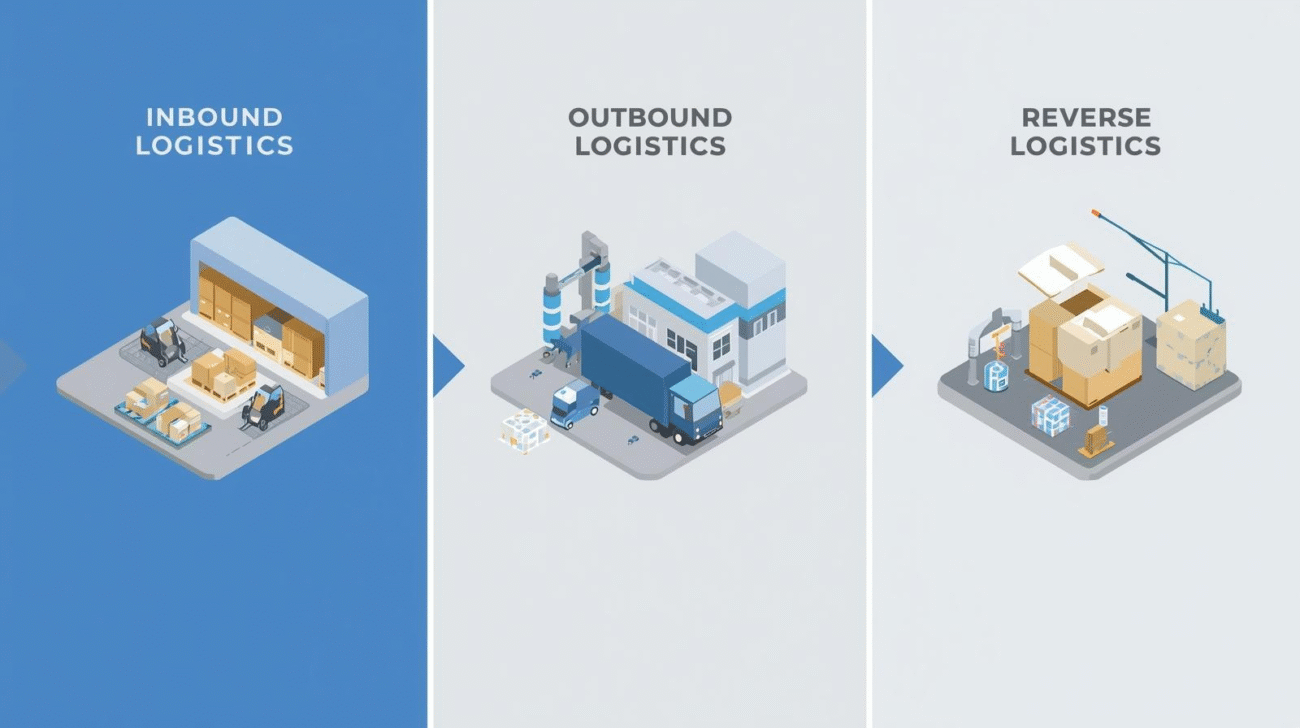
Types of Logistics – Overview
Inbound Logistics : Materials into production.
Suppliers sending raw materials (factory crates) into a production facility via truck.
Outbound Logistics : Products to customers.
Finished products (boxed goods) moving from warehouse to customers via delivery van.
Reverse Logistics : Returns handling.
Customers returning items (damaged box) back to the warehouse for processing.
Co-ordination
Coordination streamlines logistics through key processes like carrier selection, pickup scheduling, and real-time tracking.
Freight forwarders execute this coordination (not carriers who only sell vessel space).
| Process | Key Activities | Success Metrics | Tools/Strategies |
|---|---|---|---|
| Carrier Selection | Evaluate cost, reliability, transit time, safety record, service specialization | >95% on-time delivery, <2% claims ratio | RFPs, spot auctions, TMS ranking algorithms |
| Pickup Scheduling | Coordinate routes, capacity, ETAs with carriers/transporters | 24hr advance confirmation, <5% delays | Load specs (FCL/LCL), multi-stop optimization, clear communication |
| Real-Time Tracking | GPS, EDI updates, dashboard visibility across entire journey | Proactive issue resolution, accurate ETAs | TMS systems, IoT sensors, exception alerts |
Shipping vs Logistics: The difference
The difference between shipping and Logistics is explained as below,
| Aspect | Shipping | Logistics |
|---|---|---|
| Core Focus | Physical transport from point A to B | Broader planning, coordination, optimization of entire supply chain |
| Scope | Key subset of logistics: execution phase | End-to-end processes including shipping |
| Processes | Carrier selection, delivery, transport execution (truck warehouse → customer) | Inventory management, warehousing, sourcing, distribution, returns |
| Role | Tactical/Operational: movement execution | Strategic: full supply chain optimization |
| Starting Point | Post-packaging transport | Supplier sourcing through final delivery |
| Key Activities | Booking ocean freight, arranging trucks, port handling | Demand forecasting, cost minimization, multi-modal coordination |
| Examples | Books container from Chennai port to LA port | Trailblaze: factory pickup → customs → warehousing → customer delivery |
International Shipping Process
International shipping adds customs, documentation, and compliance layers to core logistics processes. It follows a structured sequence from origin to destination, often using freight forwarders for coordination.
Starts with cargo preparation, secure packaging, and transport mode selection – FCL for full containers, LCL for consolidated cargoes or Air freight for quick moving goods.
Let’s go through an example to understand the shipping process better.
Freight forwarder at the origin picks up the goods from the supplier’s factory using a truck then moves to the CFS for stuffing into the container or freight forwarder stuffs the goods into the container at the supplier’s factory then transports the goods to the terminal. After picking up the cargo the freight forwarder will issue a House Bill of Lading as a confirmation of load pick up that the cargo is under his possession.
After completing the customs clearance process the cargo is ready to be onboarded onto the Vessel. Freight forwarder will provide the customs declaration manifest for supplier’s reference.
Once customs clearance is completed shipping liner will load the container onto the vessel. Then vessel departs from the origin country. Then the shipping liner will issue the Master Bill of Lading as a confirmation that the cargo is now under liner’s possession.
Once vessel arrives at the destination liner will issue a Delivery Order to the freight forwarder. The freight forwarder at the destination clears the import clearance and picks up the goods from the terminal and then transfers it to the buyer’s place. Delivery ends with inspection at the buyer’s factory and signing-off the POD document which is called a proof of Delivery.
Step-by-Step Process
| STEP | Stage | Description | Key Player | Documents |
|---|---|---|---|---|
| 1 | Export Haulage | Goods move from shipper’s factory/warehouse to origin port/depot via truck/rail | Shipper + Transporter | Delivery order |
| 2 | Origin Handling | Inspect, consolidate, stuff into containers at port terminal | Freight Forwarder + Port Operator | Packing list |
| 3 | Export Customs Clearance | Submit export declaration, verify compliance at origin customs | Shipper + Customs Broker | Commercial Invoice, Export Declaration |
| 4 | Main Transit (Ocean/Air Freight) | Vessel/aircraft carries containers across international waters | Carrier (Hapag Lloyd, Maersk, MSC, etc.) | Bill of Lading (BOL) |
| 5 | Import Customs Clearance | Destination customs assesses duties, taxes, compliance | Buyer + Customs Broker | Import Declaration, Certificate of Origin |
| 6 | Destination Handling | Unload containers, deconsolidate cargo at import terminal | Freight Forwarder + Port Operator | Import permit |
| 7 | Import Haulage | Final truck delivery from port to buyer’s door | Buyer + Transporter | Delivery receipt |
Key Players in Shipping and Logistics
Key players in shipping and logistics have distinct roles that coordinate the international shipping process outlined as follow,
| Player | Primary Role | Key Responsibilities |
|---|---|---|
| Shipper | Goods owner/manufacturer | – Prepares cargo (packaging, labeling) – Creates export documents (invoice, packing list) – Arranges initial pickup with forwarder – Pays export duties/fees |
| Buyer (Consignee) | Goods recipient/purchaser | – Receives Bill of Lading & clears import customs – Pays import duties, VAT, taxes – Arranges final delivery – Inspects & accepts goods |
| Carrier | Vessel/aircraft owner | – Provides ocean/air transport capacity – Issues Master Bill of Lading (MBL) – Handles vessel operations at sea – Sells space to forwarders/NVOCCs |
| Transporter | Land transport provider | – Door-to-port haulage (origin) – Port-to-door delivery (destination) – Handles trucking/rail locally – Manages inland container depots |
| Freight Forwarder | Logistics coordinator | – Books carrier space & transporters – Handles all customs (export/import) – Consolidates cargo (LCL) – Issues House Bill of Lading (HBL) – Door-to-door orchestration |
| NVOCC | Non-Vessel Operating Common Carrier | – Buys bulk carrier space, resells smaller units – Acts as “carrier” to shipper – Issues own HBL while using carrier’s MBL |
| Customs Broker | Compliance specialist | – Prepares customs declarations – Calculates duties/taxes – Ensures HS code accuracy – Liaises with customs authorities |
Key Freight Service Terminology in Shipping and Logistics
FCL, LCL, trucking, and transport terms define how cargo moves through your international shipping process. These service types determine costs, speed, and coordination by key players like freight forwarders and carriers.
FCL, LCL, trucking, and service scopes determine your shipping costs and speed. Here’s what each means in simple terms:
FCL – Full Container Load
Supplier books entire 20ft or 40ft container for exclusive use.
- Perfect for: Large shipments filling 75%+ of container
- Cost: Fixed price regardless of actual volume
Key advantage: Faster (no consolidation delays), lower damage risk.
LCL – Less Than Container Load
Multiple suppliers share one container. Forwarder consolidates cargo.
- Perfect for: Small shipments (<15 CBM)
- Cost: Pay only for your volume (per CBM)
Trade-off: Slower transit due to consolidation at both ends.
Trucking Modes
FTL (Full Truck Load): Entire truck for FCL containers
LTL (Less Than Truck Load): Shared truck for LCL pallets
Service Scopes
- Door to Door: Forwarder handles everything (factory → buyer door)
- Port to Port: Only ocean leg (you handle inland transport)
- Door to Port: Pickup → origin port only (buyer handles destination)
| Term | Definition | Best For |
|---|---|---|
| FCL (Full Container Load) | Single shipper books entire 20ft/40ft container (exclusive use, sealed) | Large shipments (>15 CBM), faster transit, lower damage risk |
| LCL (Less than Container Load) | Multiple shippers’ cargo consolidated into one container by forwarder | Small shipments (<15 CBM), cost-sharing |
| Trucking | Land transport by trucks (FTL=Full Truck Load, LTL=Less than Truck Load) | Door-to-port, port-to-door, inland movement |
| Multimodal | Uses ≥2 transport modes under single contract (truck+ship+truck) | International door-to-door shipments |
| Door to Door | Complete service from shipper’s door to buyer’s door | Beginners wanting full coordination |
| Port to Port | Carrier service from origin port to destination port only | Large volumes, experienced shippers |
| Door to Port | Shipper handles inland to origin port; carrier does ocean leg | Cost-conscious shippers with local trucking |
Key Documents in Shipping and Logistics
Following are the essential Shipping Documents that shippers provide to freight forwarders for the international shipping process.
Shipper’s Letter of Instruction
A Shipper’s Letter of Instruction (SLI) is a key export document prepared by the shipper or exporter to provide detailed shipping and documentation instructions to a freight forwarder or carrier. It authorizes the forwarder to act on the shipper’s behalf, including filing customs. Typical elements include exporter/consignee details, shipment origin/destination, cargo description (quantity, weight, value, HS codes), handling instructions, and payment terms (prepaid/collect). It often serves as a limited power of attorney, signed by the exporter.
Booking Confirmation
A Booking Confirmation is a document issued by a carrier or freight forwarder to verify that cargo space has been reserved on a vessel, flight, truck, or other transport for a specific shipment. It acts as a receipt for the booking request, confirming key details and enabling tracking before the Bill of Lading or Air Waybill is issued.
It includes a unique booking number, shipper/consignee details, cargo description (weight, volume, type), equipment (e.g., container numbers or pallets), ports of load/discharge, sailing schedule with ETAs, and freight terms.
Bill of Lading
A Bill of Lading (B/L) is a vital shipping document issued by the carrier to the shipper, serving as a receipt for goods received, a contract of carriage, and proof of title to the cargo. It confirms the carrier’s responsibility for transporting the goods to the destination port and is required for customs clearance and cargo release.
As a receipt, it details the cargo’s condition, quantity, and packaging at loading. The contract outlines transport terms like origin/destination ports, freight charges, and liabilities. As title, negotiable B/Ls allow transfer of ownership via endorsement, aiding trade finance.
Standard details include shipper/consignee info, voyage number, cargo description (weight, volume, HS codes), container details, ports of load/discharge, and signature.
Bills of Lading (B/Ls) come in various types tailored to shipment specifics, negotiability, and transport modes, helping freight forwarders manage cargo ownership, contracts, and transfers.
House B/L HBL is issued by the freight forwarder or NVOCC to the actual shipper (exporter), listing the real consignee (importer).
HBL covers a single shipment within a consolidated container, acting as the contract between forwarder and shipper.
Master B/L MBL is issued by the ocean carrier to the forwarder, with the forwarder as shipper and their agent as consignee.
MBL covers the entire consolidated load, as the carrier’s contract for transport from origin to destination port.
Surrender B/L allows electronic release without originals.
Commercial Invoice
A Commercial Invoice is a legal document issued by the seller to the buyer in international trade, detailing the transaction for customs clearance, duty assessment, and proof of sale. Unlike a Bill of Lading, which proves title and carriage, it specifies the value, description, and terms without transferring ownership.
Customs authorities use it to calculate tariffs based on HS codes, quantity, value, and country of origin.
Includes seller/buyer details, invoice number/date, Incoterms, detailed goods description (quantity, unit price, total value, HS codes), currency, and certification statement with signature.
Packing List
A Packing List is a detailed inventory document accompanying shipments, itemizing contents, packaging, weights, and dimensions for verification by customs, carriers, and receivers. Unlike the Commercial Invoice (which focuses on value and sales terms), it provides logistical specifics without financial details, aiding accurate handling and customs checks.
It verifies cargo matches declarations on the Bill of Lading or House B/L, prevents disputes.
Customs use it alongside invoices for inspections; one copy stays inside packages, another outside.
Includes shipper/consignee info, package count/type (cartons/pallets), item descriptions (HS codes, quantity), per-package and total weights/volumes/dimensions, and handling notes (fragile/perishable).
Certificate of Origin (COO)
A Certificate of Origin (COO) certifies that goods in a shipment were produced, manufactured, or substantially processed in a specific country, enabling customs clearance and tariff benefits. Issued by chambers of commerce, exporters, or government bodies, it’s essential alongside Commercial Invoices, Packing Lists, and Bills of Lading for exports from India. Customs use it to apply correct duties, enforce quotas, and verify free trade agreement (FTA) eligibility for reduced tariffs; non-preferential COOs prove general origin, while preferential ones (e.g., under India-UAE CEPA, under India-Srilanka ISFTA) qualify for preferences.
| Document | Definition |
|---|---|
| SLI (Shipper’s Letter of Instruction) | Instructions from shipper/forwarder to carrier for loading cargo |
| Booking Confirmation | Official carrier acknowledgment of space reservation |
| Commercial Invoice | Detailed transaction record between buyer & seller |
| Bill of Lading (B/L) | Legal transport contract & receipt of goods |
| Packing List | Itemized cargo contents, weights, dimensions |
| Certificate of Origin | Official document proving goods’ manufacturing country |
One thought on “Shipping and Logistics: Complete Beginner Guide”